Direct Answer: Try the Sine Rule First for Side-Ratio Targets
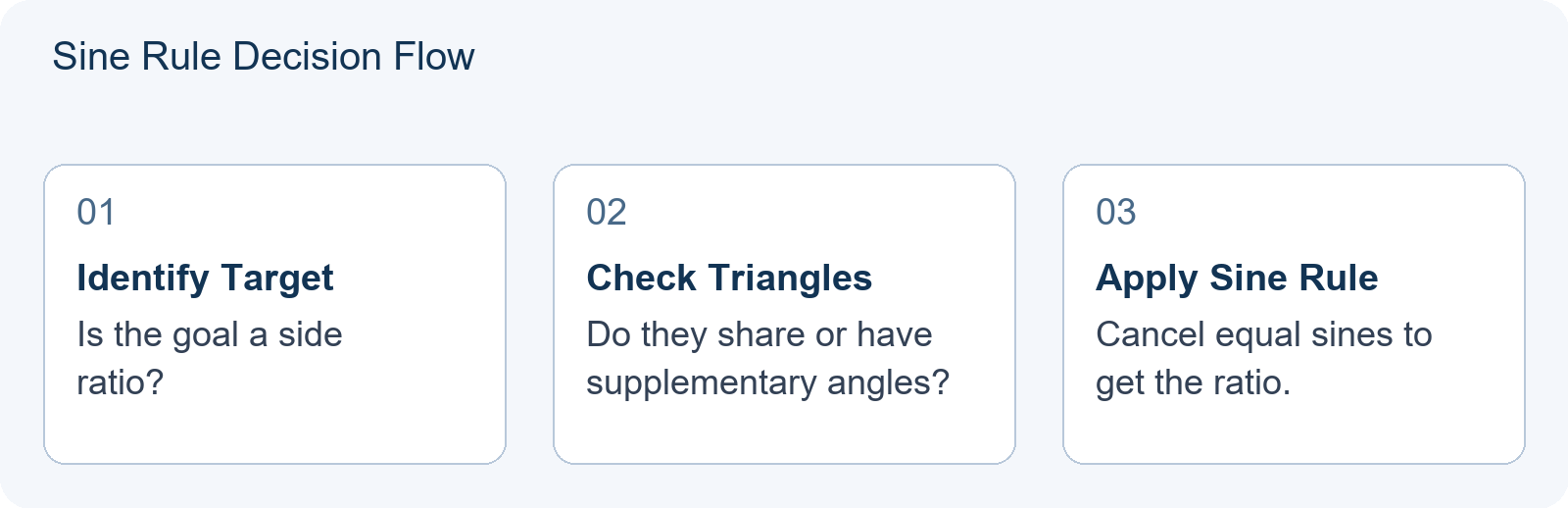
For the 2026-27 BMO Round 1, including the China-region sitting listed by Hanlin as 19 November 2026, if a geometry proof asks for a side ratio and the two sides belong to adjacent triangles that share an angle or have supplementary angles, start with the sine rule before adding an auxiliary line. This is the core BMO trigonometry decision rule: metric trigonometry often turns a ratio into a one-line cancellation. The qualification is important. The sine rule is not a universal replacement for synthetic geometry. It is strongest when the target is a ratio such as BD/DC, AB/AC or a length expressed relative to another length, and when the angle information can be paired with opposite sides.
Many BMO geometry attempts add a circle or a parallel line too early. That instinct is understandable, because auxiliary constructions reveal hidden structure. But when the given information is already about side ratios and angles in two adjacent triangles, trigonometry can produce the ratio directly. The proof then becomes shorter and less vulnerable to a missing configuration case.
The Diagnostic Table: Choosing the Right Tool
Selecting the correct theorem depends on what is given and what must be proved. The table below is a practical first-step guide for BMO geometry, not a rule that applies to every problem.
| Given information | Target goal | Recommended first step |
|---|---|---|
| Two triangles share an angle or have supplementary angles; sides in a ratio are required. | Prove BD/DC = AB/AC or a similar side ratio. | Sine rule in both triangles, then cancel equal sines. |
| Three sides are known or can be expressed algebraically; one angle or area is required. | Calculate a specific angle, length or area value. | Cosine rule or Heron’s formula. |
| Collinearity, concyclicity or tangency is required. | Prove points lie on a line or circle, or that two figures touch. | Auxiliary construction: circle, parallel line or extension. |
| No obvious shared angles; distant vertices must be related. | Relate unrelated lengths across a complex polygon. | Coordinates, vectors or a synthetic construction. |
Hanlin’s 2026 BMO course outline lists Heron’s formula among BMO2 geometry topics, so it is worth knowing. But for a pure side-ratio target, Heron’s formula is usually the wrong first move because it introduces products of side lengths and a square root. The sine rule keeps the comparison proportional.
Teaching Illustration: Deriving the Angle-Bisector Ratio
Note: This is a labelled teaching illustration, not an actual past BMO problem.
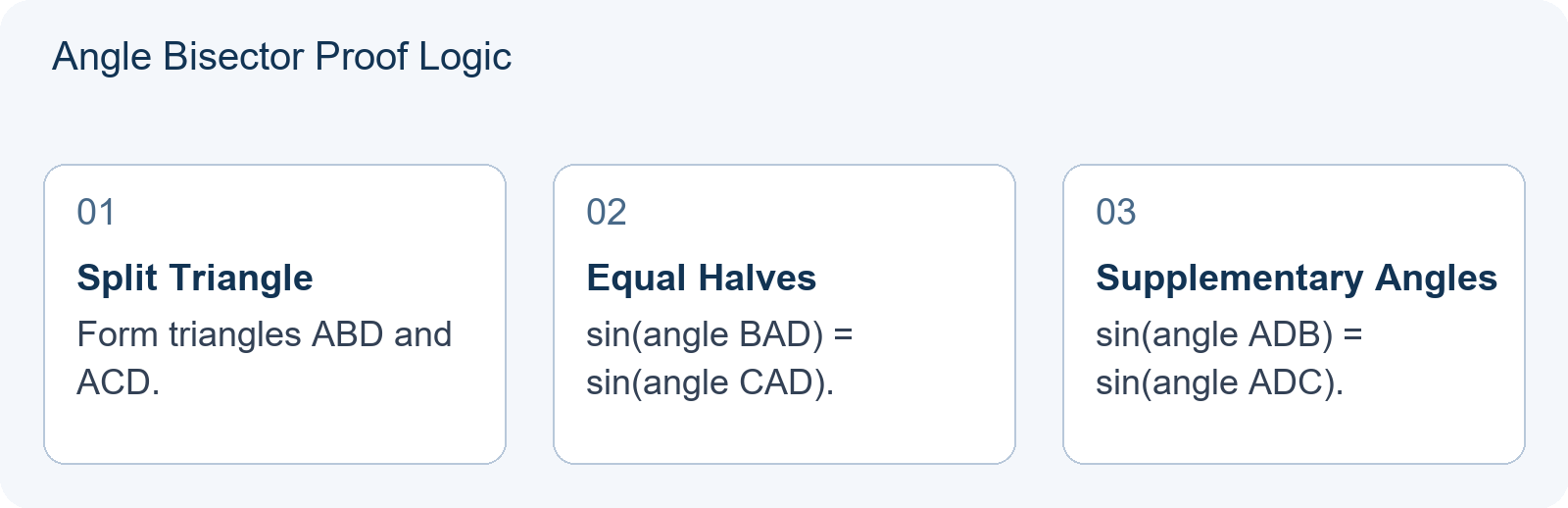
Consider triangle ABC. Let D be a point on side BC such that AD bisects angle BAC. We want to prove that BD/DC = AB/AC.
Instead of drawing a parallel line through C to meet the extension of BA, apply the sine rule directly to the two smaller triangles formed by the bisector.
- In triangle ABD: BD / sin(angle BAD) = AB / sin(angle ADB).
- In triangle ACD: DC / sin(angle CAD) = AC / sin(angle ADC).
Rearranging these equations gives expressions for BD and DC:
- BD = AB times sin(angle BAD) / sin(angle ADB).
- DC = AC times sin(angle CAD) / sin(angle ADC).
The construction-free proof is now ready. We divide the first expression by the second and compare the angle factors.
Worked Proof: Why the Sines Match
To find the ratio BD/DC, divide the two expressions:
BD/DC = [AB times sin(angle BAD) / sin(angle ADB)] / [AC times sin(angle CAD) / sin(angle ADC)].
Now analyse the angle terms.
- Bisected angles: Since AD bisects angle BAC, angle BAD = angle CAD. Therefore sin(angle BAD) = sin(angle CAD), so those factors cancel.
- Supplementary angles: Points B, D, C are collinear. Thus angle ADB and angle ADC form a linear pair, so angle ADB + angle ADC = 180 degrees. Because sin(theta) = sin(180 degrees minus theta), we have sin(angle ADB) = sin(angle ADC). Those factors also cancel.
After cancellation, we are left with BD/DC = AB/AC. The proof is complete without adding any auxiliary line. In a BMO write-up, define every point and angle before applying trigonometry, and state exactly why the sines are equal. The Hanlin 2026 BMO registration summary notes that BMO Round 1 is marked out of 10 per question and that correct process can earn partial credit, so clear justification is not decoration.
How to Spot This BMO Trigonometry Setup
Before you write anything, scan the problem for three signals. First, the target should be a ratio, not a single numerical length. Second, the two sides in the ratio should each belong to a triangle in which an opposite angle is known or easy to name. Third, the two triangles should either share an angle or contain supplementary angles at a collinear point.
If all three signals are present, write the sine rule for each triangle and divide. That step often reduces the problem to showing two sine terms are equal. The equality may come from a bisector, from parallel lines, from a cyclic quadrilateral, or from a straight line. The trigonometric step is mechanical; the geometric insight is usually concentrated in the angle comparison.


This is why BMO trigonometry is not merely formula substitution. The sine rule is a bridge between a geometric configuration and an algebraic ratio. You still need to explain the configuration correctly. A student who writes the sine rule in the wrong triangle, or who fails to state why two angles are supplementary, may lose the very marks that the calculation was meant to secure.
When to Switch to Auxiliary Constructions
The sine-rule method fails if the problem does not involve side ratios, or if the triangles do not share useful angles. If the goal is to prove that four points are concyclic, that three points are collinear, or that a line is tangent to a circle, metric trigonometry often leads to messy algebraic identities rather than geometric insight.
In those cases, return to classical synthetic geometry. Adding a circle through three points and proving the fourth lies on it, or extending lines to create similar triangles, is often more efficient. Our previous article, BMO Geometry Auxiliary Construction: Choosing Between Circle and Line, details how to decide between these structural approaches. Use the trigonometric method when the problem’s centre of gravity is a side ratio in adjacent triangles. Use auxiliary construction when the problem’s centre of gravity is incidence: points lying on lines or circles, tangency, or angle chasing across a diagram.
Write-Up Habits for Maximum Marks
BMO proof questions are marked on the quality of the argument, not only the final answer. To maximise scores when using trigonometry, follow four habits.
- Define the triangles: State explicitly that you are applying the sine rule in triangle ABD or triangle ACD. Do not assume the marker knows which triangle you mean.
- Name angles consistently: Write angle BAD, angle CAD, angle ADB and angle ADC in full at least once. Abbreviations can be used after the definitions are clear.
- Justify sine equalities: Never write that two sines are equal without a reason. Write that the angles are equal, or that they are supplementary, or that they are corresponding angles in similar triangles.
- Check the ratio direction: The side opposite angle BAD in triangle ABD is BD. The side opposite angle ADB is AB. Mixing these up changes the ratio and can invalidate the proof.
Students preparing for the next stage can use Which BMO Past Paper Should You Sit Today? A Stage-Matched Practice Ladder to choose a paper that matches their current proof fluency. If the sine-rule step feels unfamiliar, practise writing the full justification even when the algebra is short. BMO markers reward completeness.
Common Trap: Overusing the Cosine Rule
A frequent error is reaching for the cosine rule when the sine rule suffices. The cosine rule relates three sides and one included angle. It is powerful when you need to calculate a specific length or angle, especially when two sides and the included angle are known, or when all three sides are known. But it introduces squares and products of lengths, which can complicate a ratio proof unnecessarily.
If the target is a simple ratio such as BD/DC, the sine rule keeps the relationship linear and proportional. Only use the cosine rule if the problem gives three sides and asks for an angle, or if a right-angle or squared-length condition is central to the statement. For general ratio proofs in adjacent triangles, stick to the sine rule first. If the sine rule does not immediately produce cancellation, then reassess the diagram rather than forcing a longer algebraic route.
Course Fit and Preparation Strategy
Understanding when to apply trigonometric tools versus synthetic constructions is a core component of advanced BMO training. Hanlin’s published 2026 BMO Full Course outline includes a 3-hour Trigonometry block (Hanlin, 2026 BMO registration article, 15 October 2026). The decision rule in this article is a Hanlin teaching suggestion for using that topic; the outline itself does not claim that every session teaches this exact framing.
For families considering preparation, Hanlin’s 2026 BMO registration article lists the China-region BMO Round 1 registration deadline as 9 November 2026 and the exam as 19 November 2026, 17:00-20:30. That leaves time to drill specific proof decisions before the paper. If you are unsure whether structured guidance is appropriate, review The BMO1 Readiness Self-Audit: Score Yourself Out of 40 and Fix the Right Thing First to identify whether the gap is knowledge, proof writing or time management.
The key lesson is simple: BMO trigonometry is a first-response tool, not an afterthought. When a side ratio sits inside two adjacent triangles, write the sine rule for both triangles before adding a construction. If the angle comparison is clean, the proof becomes shorter and more transparent. If the angle comparison is not clean, switch to the auxiliary-construction checklist. That decision saves time and protects marks.
General event background is available at Event background.
This is an independent preparation guide, not affiliated with, endorsed by, or sponsored by UKMT.
Frequently Asked Questions
Can I use the sine rule for all BMO geometry problems?
No. The sine rule is most effective for problems involving side ratios in triangles with shared or supplementary angles. For problems requiring proofs of collinearity, concyclicity or tangency, synthetic methods such as auxiliary circles or parallel lines are often more direct.
Does Hanlin teach this specific BMO trigonometry decision rule?
Hanlin’s published 2026 BMO Full Course outline includes a 3-hour Trigonometry block. The decision rule in this article is a teaching suggestion for using that topic, not a claim that every session follows this exact framing.
What happens if I make a small error in the sine rule step?
Hanlin’s 2026 BMO registration summary notes that BMO Round 1 is marked out of 10 per question and that correct process can earn partial credit. If you correctly set up the sine rule and justify the angle equalities, your write-up is more likely to retain method marks even if a later algebraic simplification slips.