On a British Mathematical Olympiad script, marks are often lost before any mathematics happens, in the reading of the question. Determine all obliges you to produce two things — the answers, and a proof that nothing else qualifies. Show that there exists obliges you to produce one. Below is a decoder table for the stems that recur on Round 1 and Round 2 papers, and exactly what each one requires you to write down.
Two obligations, not one: the family that eats the most marks
Round 1 gives you six problems and three and a half hours for full written solutions; Round 2, listed by UKMT for January 2027, gives you four. In both, the script is the answer — there is no answer box that a correct number can be dropped into. That structural fact makes one class of misreading unusually costly.
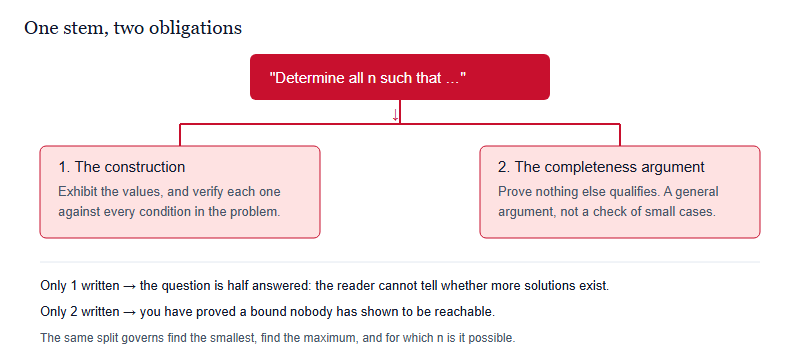
Call it the two-obligation family. Any stem of the form determine all, find all, find the smallest, find the largest, what is the maximum possible value, or for which n is it possible silently asks two separate questions:
- The construction. Exhibit the objects, the value, or the example. Show that it genuinely works, by checking it against every condition in the problem.
- The completeness argument. Prove that there is nothing else. For find all, that means proving no other solution exists. For find the smallest N, it means proving that every smaller value fails — a bound, argued in general, not a table of the first few cases.
Students who have trained mainly on multiple-choice papers — and in this cohort almost everyone has, because the Senior Mathematical Challenge is a 90-minute paper of 22 multiple-choice questions plus three 000-999 digit questions — arrive with the first half of that pair well drilled and the second half missing entirely. Finding the answer feels like finishing. On an olympiad script it is roughly half of the job, and it is usually the easier half. If you have not yet mapped how the rounds differ in what they demand of a written solution, our overview of what the British Mathematical Olympiad is sets out the shape of each paper.
The decoder table
Read the row that matches your stem before you write anything. The middle column is what a complete answer contains; the right-hand column is the failure this stem most often produces.
| Stem | What a complete answer contains | What is not enough on its own |
|---|---|---|
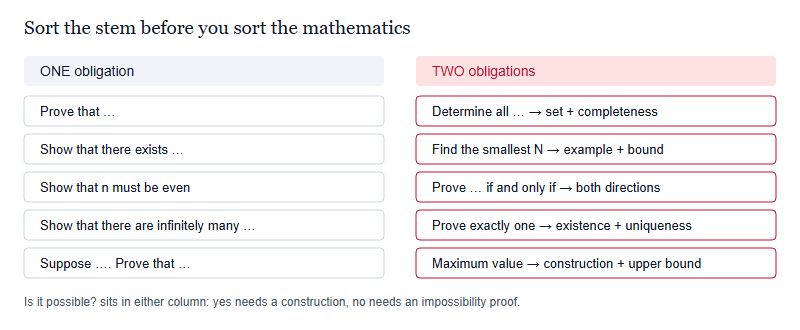
| Prove that … | A deductive argument covering every case allowed by the hypotheses. | Verification for particular values. |
| Show that there exists … | One explicit object, plus a check that it satisfies each stated condition. | An argument that one "should" exist, with no construction. |
| Show that there are infinitely many … | A construction generating arbitrarily many, or a contradiction from assuming finitely many. | A long list of examples, however long. |
| Determine all … / Find all … | The full set, verified, plus a proof that nothing outside it works. | The set alone, even if it is correct. |
| Find the smallest / largest N such that … | A construction attaining N, plus a proof that every value beyond N fails. | A value with the remark that smaller ones were tried. |
| Determine the maximum possible value of … | An example achieving the maximum, plus an upper bound argued in general. | An inequality with no case showing it is tight. |
| Prove or disprove … | A clear commitment to one side; if disproving, one counterexample verified in full. | Discussion of both sides without a decision. |
| Prove that … if and only if … | Both implications, each labelled and each argued separately. | One direction, however carefully written. |
| Show that … for all positive integers n | Induction or a general argument valid for every n. | Checking n = 1, 2, 3, 4, 5. |
| Is it possible to …? | Yes with a construction, or no with an impossibility proof (parity, invariant, colouring, counting). | "It seems impossible because attempts fail." |
| Show that n must be even (or must satisfy …) | The necessity direction only: assume the hypothesis, derive the property. | Showing that even n work — that is the converse. |
| Prove that … with equality if and only if … | The inequality, plus a characterisation of exactly when equality holds. | The inequality alone. |
| Find, in terms of n, … | A closed formula in n, plus a proof it is correct for every n. | A formula fitted to the first few values. |
| Prove that the answer does not depend on … | An invariance argument, or evaluation of a general case showing the parameter cancels. | Two or three cases giving the same number. |
| Show that at least k of them … | A lower bound argument; the extremal or averaging principle is often the tool. | Exhibiting one configuration with k of them. |
| Show that at most k of them … | An upper bound argument ruling out k + 1. | Failing to find k + 1 by hand. |
| Prove that exactly one … | Existence and uniqueness, written as two labelled parts. | Existence, with uniqueness called obvious. |
| Suppose …. Prove that … | An argument that visibly uses the supposition. | A proof that never invokes the hypothesis — usually a sign it is wrong. |
The small words that change the whole task
The verb sets the obligation; a handful of shorter words set the domain. These are read past at speed far more often than the stem itself, and each one has cost somebody a solved problem.
| Word in the question | What it fixes | The misreading it produces |
|---|---|---|
| positive integer | 1, 2, 3, … — zero is excluded | Including n = 0 and generating a false counterexample |
| non-negative | Zero is included | Discarding the boundary case, which is often where equality lives |
| distinct | Repeats are forbidden | A construction that quietly reuses a value |
| real / rational / integer | The universe you are quantifying over | Proving the statement over the wrong set |
| at least one … / some | Existence: one instance suffices | Attempting to prove it for all of them |
| every / any / each | Universal: no exceptions permitted | Treating a single verified case as a proof |
| or | Inclusive unless the problem says otherwise | Excluding the case where both hold |
| respectively | Pairs the lists in the order given | Swapping two labelled points or values |
| no two of which … | A pairwise condition on the whole set | Checking only consecutive pairs |
| consecutive | Adjacent in order, with no gaps | Reading it as merely increasing |
A 90-second pre-flight, run before you write anything
This is a routine, not advice. Run it on every problem you attempt, including practice, until it happens without effort. Ninety seconds spent here is recovered many times over in a three-and-a-half-hour paper, and it is the part of exam technique that transfers directly from your desk at home.
- Underline the stem verb. One word: prove, determine, find, show, is it possible.
- Write the obligations as a header line at the top of your working, before any mathematics. For an all-solutions stem that line reads: "(a) exhibit the set; (b) prove nothing else." That header is also the skeleton your final write-up will use.
- Circle every domain word from the second table above. Positive, distinct, integer, real, consecutive.
- Count the directions. If the stem contains if and only if, you owe two arguments and you should number them on the page now.
- Restate the problem in one sentence without looking at it. If you cannot, you have not read it, and everything after this point is wasted time.
Practise the routine on real stems rather than invented ones. Working through the question statements in an archive of genuine papers — without solving anything, just decoding the demands — is a productive half hour that costs you none of your unsat papers, and our guide to the past-paper pack and how to use it explains how to keep the papers themselves in reserve while doing it.
Where second-language readers slip specifically
Everything above applies to a native speaker too. Three things are sharper if English is not your first language, and none of them is about vocabulary size.


Mathematical English is narrower than ordinary English. In conversation, some often implies "several" and or often implies "one or the other, not both". In a problem statement, some means at least one and or is inclusive. Reading these with the everyday sense produces a solution to a different problem, and the write-up will look confident while doing it.
Conditional structure gets flattened in translation. "A holds only if B" and "A holds if B" state opposite implications, and both are commonly rendered into Chinese with the same connective in a hurry. When a stem contains only if, unless, or whenever, write the implication out with an arrow in your working before you start, and check which side you are being asked to prove.
The instruction is often split across two sentences. A typical olympiad problem sets a configuration in sentence one and issues the demand in sentence two, sometimes with a further condition in a subordinate clause at the end. Readers scanning for the verb find prove, start work, and miss the qualifier — the "where n is a positive integer greater than 2" that rules out the case their argument depends on. Read the last clause of the problem twice. It is where the constraints are hidden.
None of this changes by country. The same script standard applies whether you sit the paper in a UK school or at a registered centre overseas, which is worth remembering when you compare your work against published solutions; the practical side of sitting from outside the UK is covered in our eligibility reality check for international students.
Common questions
Does a correct answer with no proof score anything?
The written argument is what is marked. Treat an unjustified answer as leaving the question open; confirm marking guidance on ukmt.org.uk.
Is checking small cases ever a valid proof?
Only if the problem is genuinely finite and you check every case. For a statement about all n, small cases are evidence for you, not a proof.
For find all, which part should I write first?
Either order works. Label them, so the reader can see both obligations were attempted even if one is incomplete.
What if I cannot decide between prove and disprove?
Commit and argue. Testing small cases hard usually settles it, and an unresolved discussion of both sides answers neither.
This is an independent editorial guide operated by Hanlin Education for China-based international-school students. It is not affiliated with, endorsed by, or sponsored by the UK Mathematics Trust or the BMO Subtrust. Competition dates, formats and marking practice are set by UKMT and change between cycles — confirm current details on ukmt.org.uk before relying on them. The decoder table, the domain-word table and the pre-flight routine are our editorial judgement based on standard olympiad usage, not UKMT guidance, and the wording of the paper in front of you always governs. Errors reported to our editorial desk are corrected within 7 working days.