BMO1 is a 3½-hour paper of six problems requiring full written solutions — not just answers — marked out of 60 (10 per question), per bmos.ukmt.org.uk. The questions cluster into four recurring families: geometry, number theory, combinatorics and algebra. This guide explains how to recognise each family fast and the proof technique that actually scores, so your preparation targets the right skills rather than random practice.
What BMO1 actually asks of you (and why topic is only half the battle)
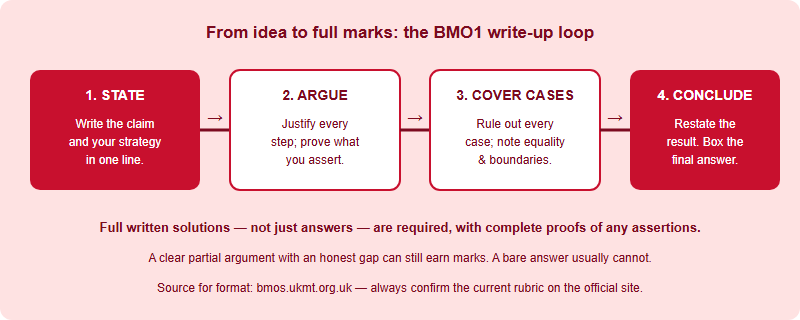
Before we split problems by topic, fix the format in your mind, because it changes how you should train. The official British Mathematical Olympiad pages state that BMO1 is a 3½-hour paper of six problems, that full written solutions — not just answers — are required, with complete proofs of any assertions you may make, and that the first problem is intended to be more accessible than the rest (source: bmos.ukmt.org.uk). Each question is worth 10 marks, and partial credit rewards the clarity of your mathematical presentation. Always confirm the current paper structure on the official site — formats are set by the BMO Subtrust, not by us.
That last point is the single biggest mindset shift for students arriving from multiple-choice contests like AMC. On BMO1 a correct final number with no justification can score close to zero, while a partial argument with a clear, honest gap can bank several marks. So “problem type” is only half the picture — the other half is write-up discipline. We will weight both. If you are still deciding whether BMO is even your route, start with What Is the British Mathematical Olympiad and the eligibility explainer for international students, then come back here for the technique layer.
One honest caveat for China-based students preparing at distance: UKMT does not publish a fixed “two geometry, two number theory” quota for any given year. The four families below are the areas competitors consistently prepare for and that recur across the freely available past papers on bmos.ukmt.org.uk — not an official syllabus split. Treat them as a training map, then calibrate against real past papers. We do not reproduce any official problems here; download them yourself and work them under timed conditions.
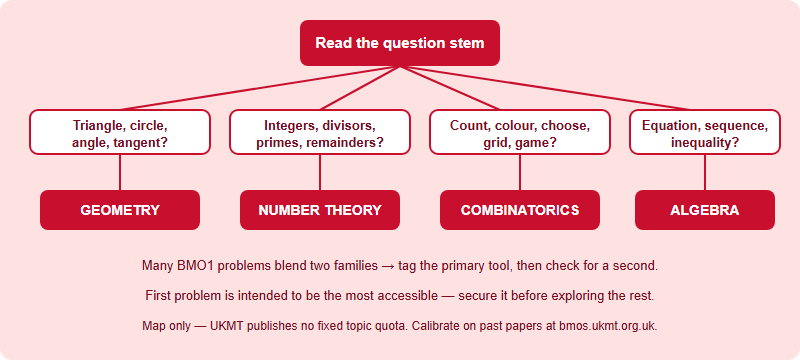
Geometry: configurations, not coordinates
Geometry is the family the official BMO pages flag most explicitly — the site recommends dedicated geometry preparation resources, which tells you it is both common and a frequent weak spot. At BMO1 level the bread-and-butter tools are angle chasing (tracking equal and supplementary angles around a configuration), circle theorems (cyclic quadrilaterals, the inscribed-angle relationship, power of a point), similar and congruent triangles, and the idea of proving points are concyclic or collinear.
The strategic trap for students trained on exam geometry is reaching for coordinates or trigonometry-by-default. Brute-force coordinate bashing can work but is slow, error-prone under time pressure, and often buries the elegant idea the problem rewards. The strongest BMO1 geometers draw a large, accurate diagram first, mark every equal angle and length, and look for a hidden cyclic quadrilateral or a pair of similar triangles before committing to any heavy machinery. Build the habit: a clean diagram is half the proof and is itself worth marks because it communicates your reasoning.
A first-party note from coaching China-based students: the gap on geometry is rarely “not knowing the theorems” — it is fluency turning a sentence of conditions into a marked-up figure, and confidence that an angle-chase is a complete proof. Drill that translation step on past papers until it is automatic.
Number theory: divisibility, modular arithmetic and bounding
Number-theory problems on BMO1 reward a small, deep toolkit rather than exotic results. The core moves are divisibility arguments, modular arithmetic (working mod a clever choice of n to expose a contradiction or force a pattern), the structure given by prime factorisation, and bounding — squeezing an integer between two consecutive values to pin it down. Many problems hinge on choosing the right modulus; the difference between a stuck student and a solver is often just testing the problem mod 3, mod 4, mod 8 or mod 9 systematically.
The write-up discipline here is brutal: a worked example or a checked small case is evidence, not a proof. If you claim “no solutions exist”, you must rule out all cases, usually via a modular or size argument. A common, costly mistake is verifying a pattern for the first few integers and then asserting it holds forever without justification. State your induction or your modular contradiction explicitly. For the algebraic-manipulation muscle that underpins this — factoring, working with sequences, and rigorous casework — the foundations laid in our JMO-to-Cayley reading plan carry directly upward.
| Problem family | Signal words in the stem | Core techniques to drill | Most common way to lose marks |
|---|---|---|---|
| Geometry | triangle, circle, tangent, angle, midpoint, concyclic | angle chasing, circle theorems, similar triangles, concyclic/collinear proofs | asserting a diagram fact without proof; reaching for coordinates too early |
| Number theory | integer, divisor, prime, remainder, divides, digits | modular arithmetic, divisibility, prime factorisation, bounding/squeeze | checking small cases then claiming “always”, with no general argument |
| Combinatorics | count, colour, choose, grid, tournament, configuration, game | bijections, pigeonhole, extremal principle, invariants, careful casework | vague “you can always do this” instead of an explicit construction or strategy |
| Algebra | equation, sequence, polynomial, inequality, function, maximum | substitution, factorisation, AM–GM and other inequalities, telescoping, induction | dividing by a possibly-zero quantity; ignoring boundary/equality cases |
Combinatorics: construct, bound, then match
Combinatorics is where many strong calculators stall, because the problems test ideas rather than formulae. Typical BMO1 combinatorics asks you to count configurations, prove a colouring is possible or impossible, find the largest or smallest set with a property, or analyse a two-player game. The recurring techniques are the pigeonhole principle, bijections (counting one set by matching it to another), invariants and monovariants (a quantity that never changes, or only moves one way), the extremal principle (look at the largest or smallest object), and disciplined casework.
For “find the maximum k” problems, the winning structure is almost always two-sided: construct an explicit example achieving k, then prove no larger value is possible. Students routinely do one half and assume the other is “obvious” — and lose half the marks. When a problem describes a process or a game, hunt for an invariant first; it collapses many problems that look impossibly open-ended. The honest difficulty here is that combinatorics rewards seeing the idea, and ideas come from volume of varied past-paper exposure, not from memorising a method list.
Algebra: manipulation with guardrails
Algebra problems span functional equations, polynomials, sequences and inequalities. The core toolkit is clever substitution, factorisation, standard inequalities such as AM–GM and Cauchy–Schwarz, telescoping sums and products, and induction for statements indexed by the integers. Inequalities in particular reward knowing a small number of standard tools cold and recognising which one fits.


The guardrails matter as much as the techniques. Two error patterns cost marks every year: dividing by an expression that might be zero without checking, and ignoring equality or boundary conditions in an inequality (you usually must state when equality holds to finish cleanly). Treat algebra as manipulation with a checklist: are all transformations reversible, is every denominator nonzero, and have I addressed the equality case? That discipline is what separates a 10 from a 6.
A 12-week training map across all four families
Knowing the families is step one; allocating your hours is step two. Because UKMT publishes no fixed topic split, the safest preparation is balanced coverage with extra weight on your weakest family and on geometry (the area the official site singles out for prep resources). Below is a defensible template — adjust the mix to your own past-paper diagnostics, and always work from official past papers on bmos.ukmt.org.uk under genuine 3½-hour timing.
| Phase | Focus | What “done” looks like |
|---|---|---|
| Weeks 1–3 | Geometry fundamentals: angle chasing, circle theorems, similar triangles | You can mark up any configuration and spot a cyclic quad without prompting |
| Weeks 4–6 | Number theory: modular arithmetic, divisibility, bounding | You instinctively test a problem across several moduli and write complete case-kills |
| Weeks 7–9 | Combinatorics & algebra: invariants, pigeonhole, inequalities, induction | For a “find max k” problem you produce both a construction and a matching bound |
| Weeks 10–12 | Full timed past papers + write-up review | You self-mark against published solutions and your gaps are shrinking paper-on-paper |
For China-based international-school students, two adjustments help. First, since BMO1 is sat in the UK academic calendar, plan backwards from the official sitting date published on ukmt.org.uk each year — confirm dates and entry on the official site rather than assuming. Second, because qualification typically runs through the Senior Mathematical Challenge, your route in matters as much as your technique; the eligibility details for students outside the UK are covered in our BMO eligibility guide. The technique map above is the part you fully control today.
FAQ
How many questions are on BMO1 and how long is it?
BMO1 is a 3½-hour paper of six problems requiring full written solutions, with the first problem intended to be the most accessible (per bmos.ukmt.org.uk).
Does BMO1 have fixed numbers of geometry or number-theory questions?
No published quota. Geometry, number theory, combinatorics and algebra all recur, but the exact mix varies by year — calibrate on official past papers.
Do I lose marks for a correct answer without working?
Yes. Full written solutions with complete proofs are required; a bare final answer typically scores little, while a clear partial argument can earn marks.
Where can I find official BMO1 problems to practise?
Past papers and solutions are published on bmos.ukmt.org.uk. Work them under genuine 3½-hour timing and self-mark against the official solutions.
Next steps
- BMO past papers, and how to use them — problem types are best learned from the real papers
- Preparation resources — targeted problem sets for each of the topic areas above
- The BMO rounds explained — how these problem types differ between BMO1 and BMO2
This is an independent editorial guide operated by Hanlin Education for China-based international-school students. It is not affiliated with, endorsed by, or sponsored by the UK Mathematics Trust (UKMT) or the BMO Subtrust. Competition formats, dates, entry routes and rules are set by the official organisers — always confirm current details on ukmt.org.uk and bmos.ukmt.org.uk. We do not reproduce official problems; practise from the past papers published on the official site. Confirmed errors are corrected within 7 working days.
Ready to practise on the real thing? Work through a full set of BMO past papers (BMO1 & BMO2) with a four-step method in our dedicated pack.