The short answer: yes, international students can sit the British Mathematical Olympiad (BMO), and students from at least eight countries do so each year. But the eligibility question splits into two separate sub-questions that the United Kingdom Mathematics Trust (UKMT) treats very differently: (1) can I sit BMO Round 1 and have my paper marked? and (2) can I be selected for the UK team at the International Mathematical Olympiad? The answers are not the same. This guide is the editorial reference international students preparing for BMO from outside the UK — particularly from Chinese international schools — need to separate the two questions, understand the discretionary entry path, and know what a BMO Distinction actually signals on a university application.
The Two-Question Framework
Almost every confusion about BMO and international students comes from collapsing two questions into one. Keep them separate:
| Question | Who is eligible | What you get |
|---|---|---|
| Q1: Can I sit BMO1 / BMO2? | Any student in Year 13 or below, in pre-university education, whose school enters them via the discretionary or standard entry route | A marked paper, a Distinction / Merit / Participation certificate, internationally recognized scoring |
| Q2: Can I be on the UK IMO team? | Holders of a British passport, OR students with three years of full-time UK secondary education before leaving school | Eligibility to be invited to the UK National Mathematical Olympiad training camp and selected for the 6-student UK IMO team |
For a student at an international school in Shanghai, Beijing, or Shenzhen with no UK schooling history, the answer to Q1 is yes and the answer to Q2 is no. That distinction matters because the scoring credential from Q1 is what travels on a university application — the IMO team destination from Q2 is not what most international applicants are after in the first place. The path is real, the recognition is real, and the rules are administered consistently.
The Eligibility Decision Tree
Reading the rules in chart form removes ambiguity. The decision tree below applies the BMO Subtrust’s published eligibility policy to the three typical international student situations.
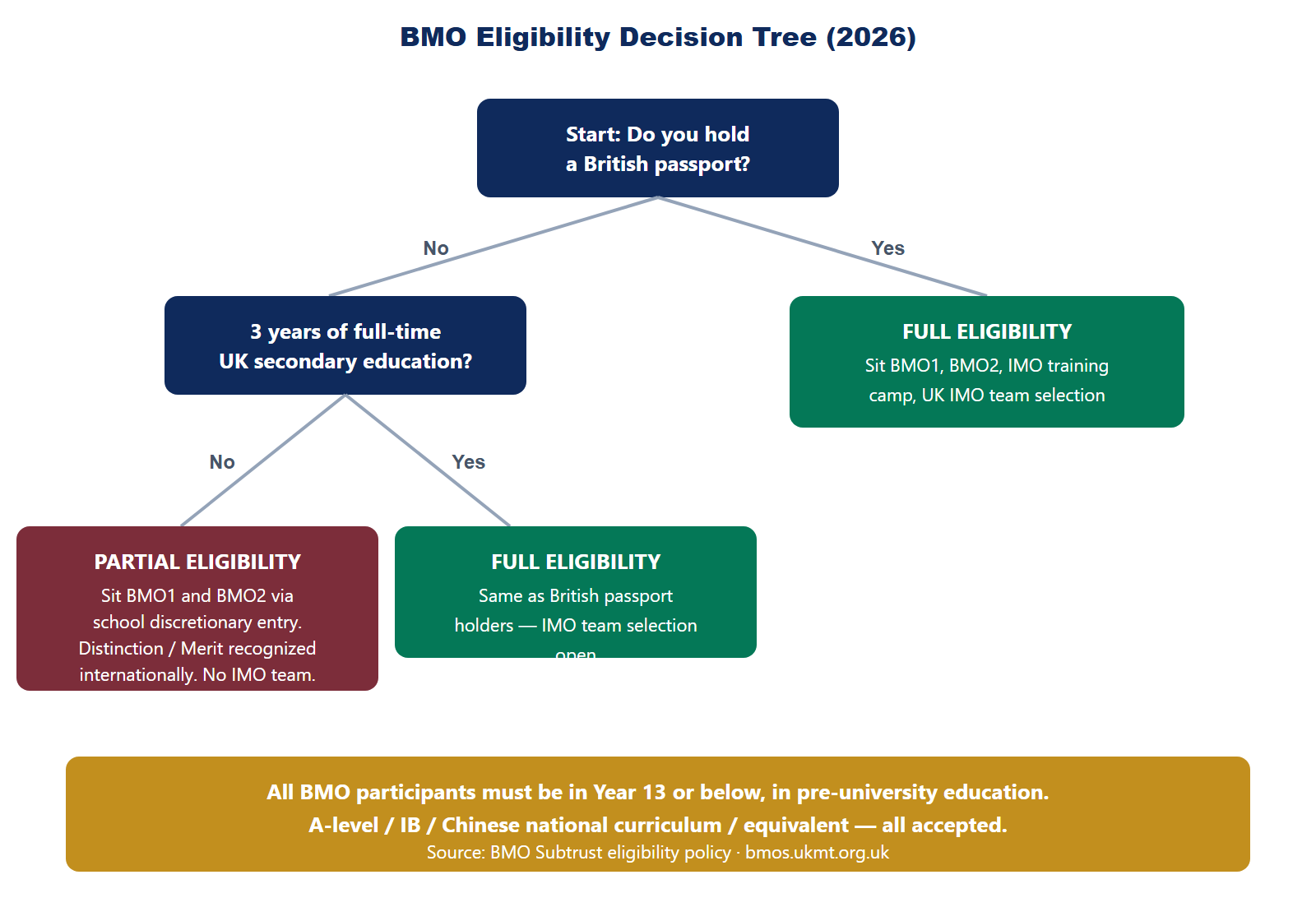
The third path — partial eligibility — is the one most Chinese international school students are on. The credential pathway (sit BMO, score Distinction, list it on the Common App or UCAS) is wide open. The team-selection destination is not. For students whose plan is UK or US university admissions rather than competing for the UK at IMO, the partial-eligibility path is the path that matters.
How Discretionary Entry Works
Discretionary entry is the mechanism by which schools outside the UK — or UK schools entering candidates who would not otherwise qualify via SMC — can put students into BMO1 directly. The mechanism has three operational features international families should understand:
- Purchased by the school: BMO entries cannot be made by individual students. The student’s school enters them as part of an institutional cohort, and pays UKMT the per-candidate fee.
- Marked under the same standard: Discretionary entries are marked by the same UKMT markers against the same mark scheme as standard UK candidates. There is no separate “international” scoring band.
- Awarded the same certificates: A discretionary BMO candidate who reaches the Distinction threshold receives the same Distinction certificate as a UK candidate at the same score. The certificate does not flag the entry route.
In practical terms, this means an international student’s BMO Distinction is structurally identical to a UK student’s BMO Distinction. The only difference is downstream: a UK Distinction holder is eligible for invitation to BMO2 and then to the UK IMO training camp; an international Distinction holder is eligible for BMO2 invitation (top 10% rule applies the same way) but not for IMO team selection unless they meet the passport-or-three-years rule.
The International Cohort · Who Actually Takes BMO from Outside the UK
The international cohort is not theoretical. In recent years, schools in the following countries have entered candidates to BMO1 and BMO2 via the discretionary path:
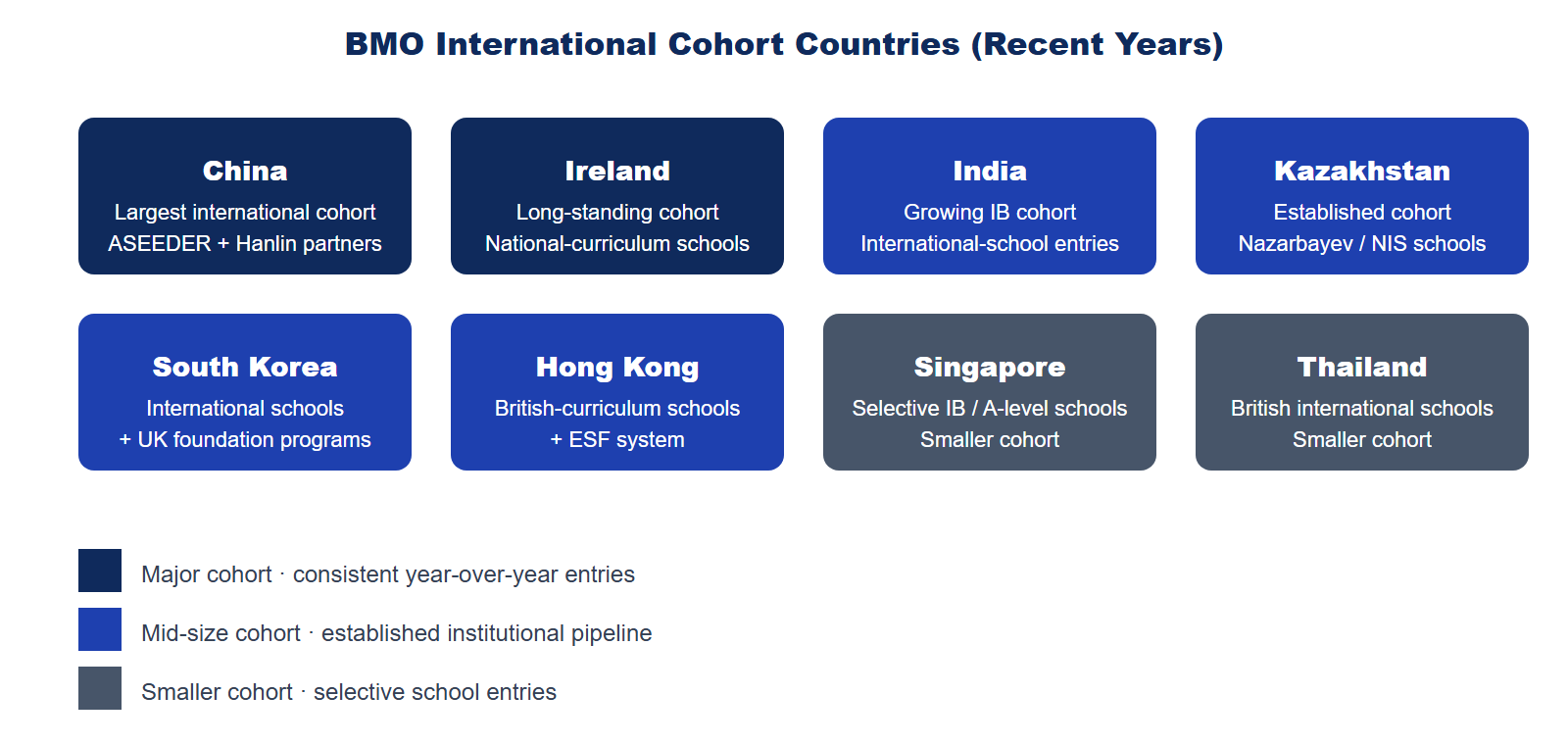
Two things are worth noting from this map. First, the international cohort is concentrated in countries with strong British-curriculum infrastructure (Ireland, Hong Kong, Singapore, Thailand) or with established UKMT partnerships (China via ASEEDER, Kazakhstan via Nazarbayev Intellectual Schools). Second, China is currently the largest international cohort by candidate count — a development of the past five to seven years driven by the expansion of A-level and IB programs across Chinese international schools and the dual-track UK/US application strategy.
The China Registration Path · ASEEDER and Authorized Partners
For Chinese international school students, the registration path is administered through ASEEDER (the UKMT-authorized China partner) together with authorized school programs and education partners, including Hanlin Education (linstitute.net), which operates this editorial site. The operational calendar runs as follows:
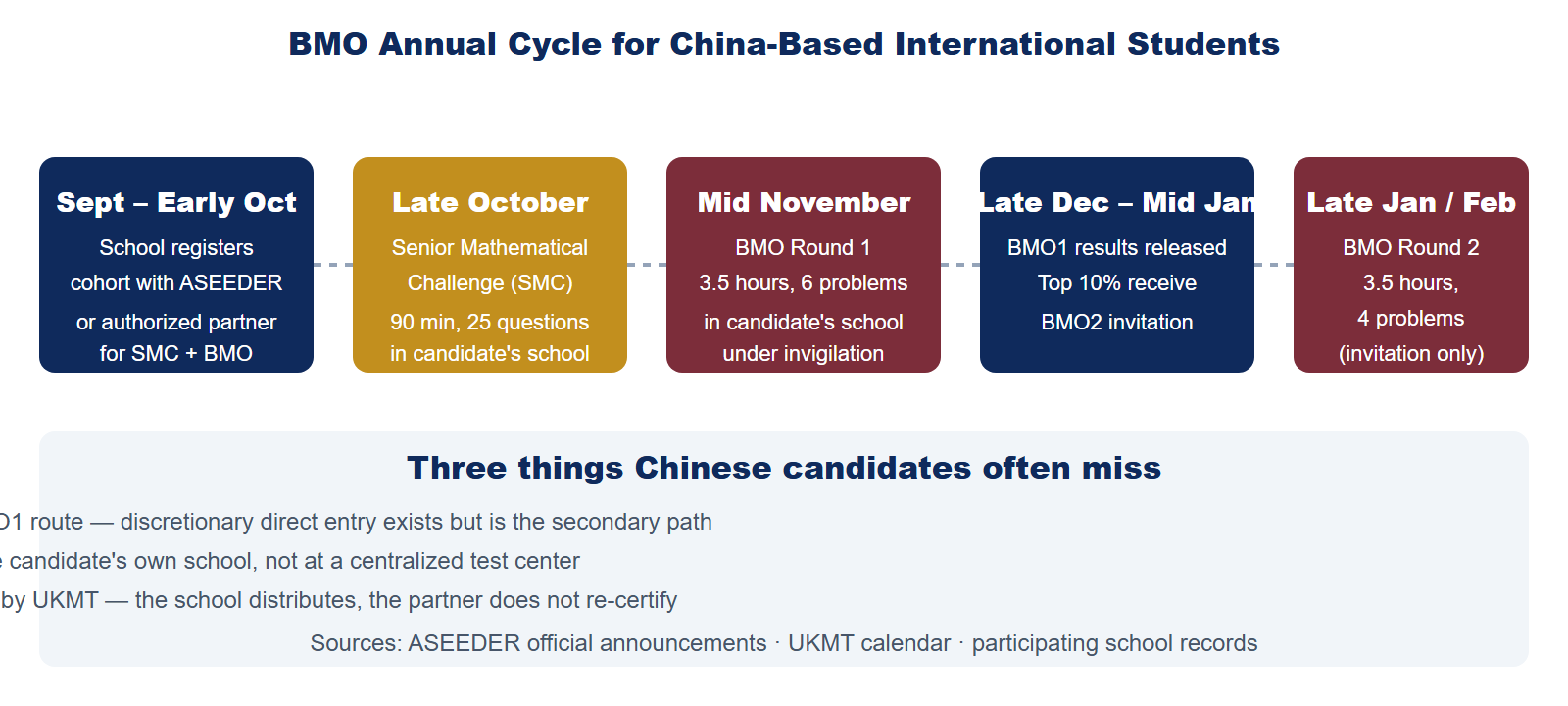
The most common operational confusion among Chinese families is the relationship between SMC and BMO1. SMC is taken in late October; BMO1 is taken roughly four weeks later in mid-to-late November. Both papers are sat in the candidate’s school under invigilation. The standard route is: sit SMC → score above the published cut-off → receive BMO1 invitation. The discretionary route — where a school enters a candidate directly to BMO1 without an SMC qualifying score — is the fallback for strong candidates who missed SMC or are entering BMO mid-cycle. Both routes are valid; both lead to the same marked paper and the same certificate.
What a BMO Distinction Actually Signals on a UK Application
For a Chinese international school student applying to UK mathematics-heavy programs — Oxford, Cambridge, Imperial College London, Warwick, UCL — a BMO Distinction is one of the most legible mathematics signals an applicant can carry. Admissions tutors at these institutions have decades of calibration on what a BMO Distinction predicts about undergraduate readiness, because they have read it on UK applications continuously since 1965. The signal does not lose strength when it comes from a Chinese applicant rather than a UK applicant — it gains specificity because it differentiates the candidate within the dense pool of Chinese applicants who have only A-level grades or IB scores.
Specifically:


- Oxford Mathematics: BMO performance is one of the factors that may inform shortlisting alongside the Mathematics Admissions Test (MAT). A Distinction does not bypass MAT but can support a borderline shortlisting decision.
- Cambridge Mathematics: STEP performance remains the dominant offer-conditional credential, but BMO records are routinely cited in the applicant’s academic profile and supplementary forms.
- Imperial, Warwick, UCL: BMO is read as a strong supporting signal of mathematical aptitude, particularly when paired with A-level Mathematics A* and Further Mathematics A*.
A BMO Merit (the certificate awarded below Distinction but above Participation) is also a positive signal — it indicates the student attempted and made substantive progress on a paper most A-level students would find untouchable. A Participation certificate is essentially evidence that the student showed up to a senior olympiad — not without value, but not a differentiator at the most competitive tier.
What a BMO Distinction Signals on a US Application
For a Chinese applicant to selective US universities — MIT, Caltech, Stanford, Princeton, Harvard — the calibration is different. US admissions officers read primarily the AMC → AIME → USAMO pathway and the Putnam competition for college-level mathematics. A BMO Distinction is a recognizable signal in this context because admissions officers know what international mathematics olympiads look like, but it does not substitute for AMC / AIME performance in the way it can substitute for STEP at Cambridge.
The practical implication: for a Chinese applicant targeting both UK and US universities, the dual-track strategy — sitting both AMC (with AIME / USAMO follow-on) and BMO — is the optimal allocation of competition effort. The calendars are compatible: AMC 10/12 in early November, AIME in February, USAMO in April; BMO1 in mid-November (one week after AMC), BMO2 in late January. The skill transfer is high (both pathways test similar olympiad-level problem-solving), and the dual record signals seriousness to admissions readers in both systems.
Common Misconceptions to Clear Up
Five recurring misconceptions among international students considering BMO:
- “I need to be in the UK to take BMO.” No. BMO1 is taken in the candidate’s own school under invigilation, anywhere in the world. The school is the entry mechanism, not a UK test center.
- “International students get easier marking.” No. The mark scheme is identical; the cut-off for Distinction is the same UK cut-off; the markers are the same UKMT markers.
- “BMO is only worthwhile if I’m targeting Oxbridge.” No. BMO Distinction is a recognized signal across UK mathematics-heavy programs and is read by US selective universities as well. Applicants outside the Oxbridge-Imperial-Warwick top tier also benefit.
- “I have to take SMC first to take BMO.” Not strictly. The standard route is SMC → BMO1; the discretionary route allows direct BMO1 entry for strong candidates whose schools enter them. Most candidates take both because the prep overlaps heavily.
- “BMO is too hard for international students whose first language isn’t English.” Language is not the bottleneck. BMO problems are stated in roughly 50–150 words of standard mathematical English with minimal idiomatic content. Strong A-level / IB students with intermediate English read BMO problems comfortably.
Frequently Asked Questions
Can international students take BMO?
Yes. International students whose schools enter them via the discretionary route can sit BMO Round 1 and BMO Round 2 in their own school, under invigilation, anywhere in the world. Their papers are marked against the same UK mark scheme by UKMT markers, and they receive the same Distinction / Merit / Participation certificates as UK candidates. The only restriction is for the UK IMO team: only British passport holders or students with three years of full-time UK secondary education can be selected.
Can Chinese students take BMO?
Yes. Chinese international school students are currently the largest international cohort taking BMO. Registration runs through ASEEDER (the UKMT-authorized China partner) and authorized school programs. The school enters the cohort in September or early October; SMC is taken in late October; BMO Round 1 is taken in mid-to-late November. All papers are sat in the student’s own school under invigilation.
Do I need a British passport to take BMO?
No. You do not need a British passport to sit BMO Round 1 or Round 2 or to receive a Distinction. The British passport (or three years of UK secondary education) requirement applies only to UK IMO team selection. For all other purposes — sitting the paper, being marked, receiving certificates, listing the credential on UK and US university applications — international students are treated identically to UK candidates.
How do I register for BMO from China?
Registration is done by your school, not by you as an individual student. Your school works with ASEEDER (the UKMT-authorized China partner) or another authorized program to enter the cohort for the year’s SMC and BMO sittings. If your school does not currently participate, you can ask the head of mathematics to contact ASEEDER directly, or work through an authorized partner such as Hanlin Education (linstitute.net) to facilitate a school registration.
Does a BMO Distinction help with Oxbridge math admissions?
Yes. Oxford Mathematics and Cambridge Mathematics admissions tutors recognize BMO Distinction as a strong supporting credential alongside the dominant offer-conditional tests (MAT for Oxford, STEP for Cambridge). A BMO Distinction does not replace MAT or STEP, but it provides early-stage evidence of olympiad-level mathematics aptitude that supports shortlisting and academic profile assessment.
Should I do AMC and BMO at the same time?
For dual-track UK and US applicants, yes. The calendars are compatible (AMC in early November, BMO1 one week later in mid-to-late November). The skill transfer is high because both pathways test olympiad-level problem-solving. The combined record — AMC distinguished score plus BMO Distinction — is one of the strongest international mathematics profiles a Chinese applicant can carry.
What if my school has never entered students to BMO?
Most international schools with A-level or IB mathematics programs can begin entering BMO candidates the following academic year by contacting ASEEDER (in China) or by entering directly via the BMO Subtrust’s international entry process. The school needs to designate a teacher to invigilate the paper under standard UKMT conditions and to handle the institutional registration and fee payment. The lead time is typically one academic cycle — if your school registers in September, the first BMO sitting can be that November.
Related Resources
- 📘 Foundation guide → What Is the British Mathematical Olympiad? A 2026 Complete Guide
- 📋 Senior stage overview → Senior Stage: SMC, Senior Kangaroo, MOG, BMO
- 📋 BMO deep-dive → BMO Round 1 and Round 2
- 📋 All UKMT competitions → UKMT Competitions Hub
- 📚 Past papers → Resources
- 📞 Editorial desk → Get in Touch
This guide is published by the independent editorial desk at en.bmo.org.cn. We are not affiliated with the United Kingdom Mathematics Trust, the BMO Subtrust, or ASEEDER. All facts on this page are cross-referenced against the UKMT site (ukmt.org.uk), the BMO Subtrust site (bmos.ukmt.org.uk), ASEEDER’s published partner communications, and participating-school records. Our editorial standards are set out in full on the Academic Integrity page; in summary: every page is verified against primary sources, written in plain language for parents and students new to the pipeline, and corrected within seven working days of any reported error.